
Why Agents Are Pricing Below Market Again — And What It Signals
In San Francisco’s current housing market, pricing homes meaningfully below expected value has emerged again as a deliberate strategy. Limited inventory, persistent demand, and hyper-local buyer reference points are driving it — with Forest Knolls illustrating these dynamics clearly.
Why pricing below market has returned
Why this strategy works right now
Why Forest Knolls illustrates this so clearly
What this means for sellers
Why pricing below market has returned.
In several San Francisco neighborhoods, a familiar pattern has started to reappear: homes are being priced meaningfully below where they ultimately sell. This isn’t a signal of a weakening market. In most cases, it reflects the opposite.
With inventory still limited and buyer interest remaining strong, pricing below expected value has returned as a way to engage demand, encourage comparison, and let the market clearly establish value based on buyer response rather than assumption.
Why this strategy works right now.
In the current San Francisco real estate pricing strategy environment, when supply is constrained, buyers pay close attention to what’s available. Pricing a home lower draws more buyers into the conversation early, creates urgency without forcing it, and gives sellers real-time feedback on how buyers are reacting to the home itself — not just the list price.
In this environment, multiple offers aren’t about hype. They’re about information. They help answer a practical question: what are buyers actually willing to pay for a home that feels complete, well positioned, and thoughtfully prepared?
Homes that are well done tend to benefit from this clarity. Homes that raise questions — about condition, layout, or how they live day to day — tend to get tested quickly.
Why Forest Knolls illustrates this so clearly.
Forest Knolls is an unusually nuanced neighborhood, which makes it a helpful lens for understanding why pricing strategies are evolving again.
Because Forest Knolls touches several distinct areas — including Cole Valley, the Inner Sunset, and Midtown Terrace — buyers often arrive with very different reference points. Some are prioritizing walkability and proximity. Others are focused on light, outlook, and space. Those mental comparisons influence how pricing is interpreted more here than in neighborhoods with a single, consistent identity.
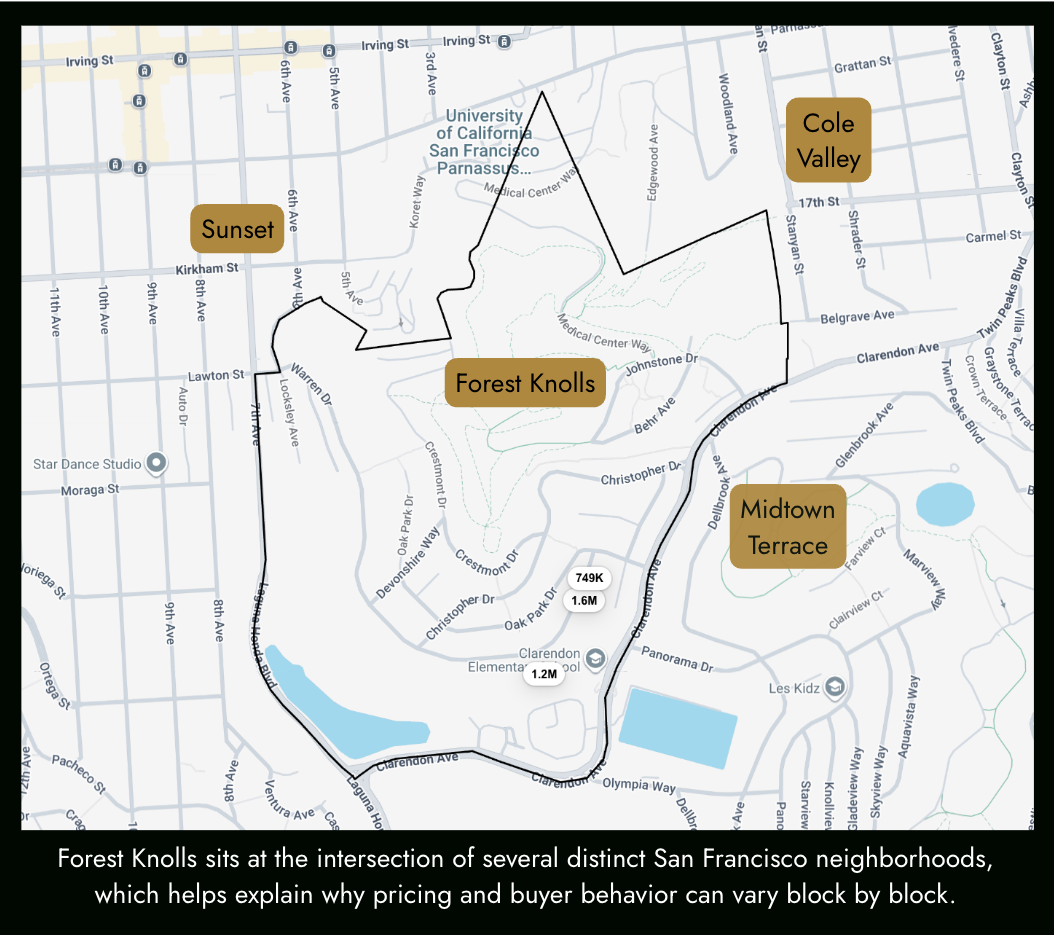
Two homes in Forest Knolls can look similar on paper, yet compete in entirely different buyer conversations depending on where they sit and what buyers are weighing them against.
Two homes, two buyer conversations.
A smaller, fully updated home closer to the Cole Valley side of Forest Knolls may attract buyers who value design, walkability, and immediacy — even if square footage is modest.
Meanwhile, a larger home higher up, with more light and outlook but less walkable access, may draw buyers focused on space, views, and day-to-day livability.
On paper, these homes may appear comparable. In practice, they’re often competing in two different mental markets. Pricing strategies that acknowledge that distinction tend to perform better than those that don’t.
What this means for sellers.
Pricing below market isn’t about leaving value on the table. It’s about creating clarity.
In today’s market, strategy matters more than slogans. Homes that are thoughtfully prepared and priced with intention give buyers the confidence to engage — and allow the market to do what it does best when demand is present. Forest Knolls simply makes that dynamic easier to see.
As inventory continues to be limited in San Francisco, especially for single family homes, we expect this trend to continue.
For more context on how Forest Knolls compares to nearby micro-markets, see our Forest Knolls neighborhood guide