
The $1M Over-Ask Market: What These San Francisco Sales Actually Mean
If you’ve been watching the market recently, you’ve probably seen the headlines:
Homes selling hundreds of thousands — sometimes over a million dollars — above asking.
That’s not exaggerated.
We’re seeing it across San Francisco:
A home in Noe Valley closed nearly $2M over asking
An Inner Sunset property sold more than $1.8M above the list price
A Diamond Heights home drawing double-digit offers and trading over $1.3M above asking
These aren’t isolated stories.
But they’re also easy to misread.
This Isn’t Just a “Hot Market” Story
At first glance, it looks like buyers are simply overpaying. What’s actually happening is more structured than that.
These outcomes are being driven by:
Very limited inventory
Pricing strategies designed to create competition
Buyers who are ready to act when the right home appears
The list price, in many cases, is not the expected outcome — it’s the starting point.
Where This Is Happening Most
The biggest overbids are not random.
They tend to show up in:
Single-family homes
Established neighborhoods like Noe Valley, the Sunset, the Richmond, and Presidio Heights
Homes with layouts and locations buyers already understand
When these homes come to market, they’re not being discovered.
They’re being anticipated.
Buyers are already watching. Already prepared. Already engaged.
That’s why competition forms quickly — and pushes pricing beyond the list.
It’s Not Just Any House — It’s the Right One
The most aggressive results are concentrated around homes buyers already have a strong point of view on — the ones that are hard to replicate.
That might be:
The perfect Mid-century Modern home with views
Well-executed renovation with a classic floor plan and indoor/outdoor living
A house that just “lands” the moment you walk in
These are the homes buyers aren’t debating — they’re competing for.
That’s where you’re seeing the biggest gaps between list price and sale price.
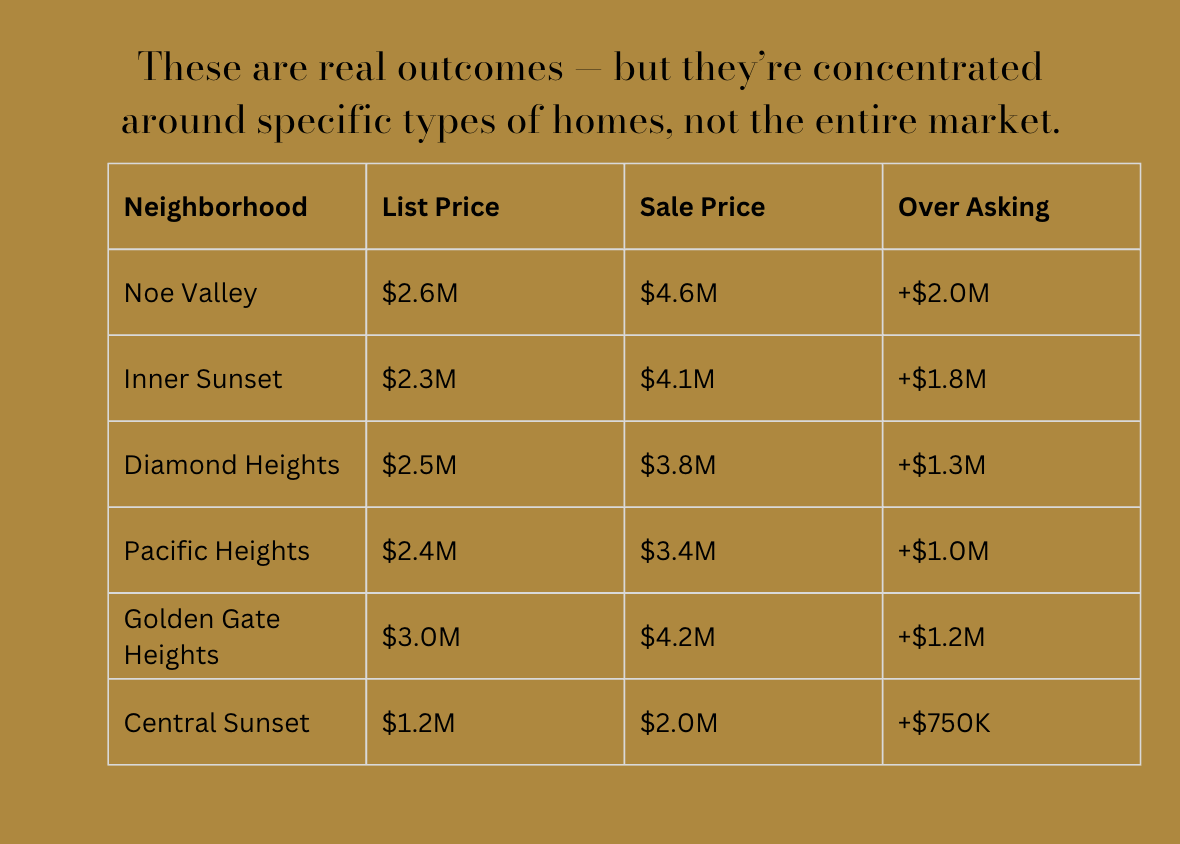
Actual Home Sales in San Francisco according to SFARMLS
There’s Still a Deep Buyer Pool Behind It
It’s also worth acknowledging who the buyers are right now.
San Francisco still has a deep pool of well-capitalized buyers — many bringing significant liquidity into the transaction, and in some cases paying cash.
At the same time, the rent-versus-own equation has shifted for a lot of people.
So when the right home comes up — especially one they feel conviction around — buyers are willing to step in decisively.
Why Buyers Are Willing to Stretch
Another important piece of this:
Buyers aren’t necessarily reacting to the list price — they’re reacting to the opportunity.
When inventory is limited, the cost of waiting becomes real.
So when a home checks the right boxes:
Location
Layout
Long-term livability
Buyers are willing to stretch to secure it.
That’s what’s driving these outcomes — not irrational behavior, but focused competition.
Why This Doesn’t Apply to Every Listing
One of the biggest misconceptions right now is that everything is selling this way. It’s not.
These results tend to concentrate around homes that:
Fit what buyers are already looking for
Easy to understand and evaluate
Priced to generate engagement early
Other homes — even nearby — can see a much more measured response.
What This Means for Sellers
If your home fits into this segment, the opportunity is real.
But it’s not automatic.
The homes achieving these kinds of results are:
thoughtfully prepared
priced with a clear strategy
and positioned to create momentum in the first week
That early window still matters — a lot.
What This Means for Buyers
For buyers, the takeaway is straightforward:
You’re not just competing on price — you’re competing on readiness.
The homes generating this level of interest are the ones buyers already understand and are prepared to act on quickly.
That means:
doing the work upfront
understanding value before offer day
and being ready to move when the right opportunity appears
The Takeaway
The “$1M over asking” sales are real.
But they’re not random — and they’re not happening everywhere.
They’re the result of a market where:
supply is tight
demand is focused
and competition forms quickly around the right homes
Understanding that is what helps both buyers and sellers navigate this market more effectively.
See How This Fits Into the Bigger Picture
This is one part of what we’re seeing right now — I’ve outlined the broader market dynamics in the latest Snow Report.
We’re also seeing it play out very clearly in the Sunset, which you can explore here.
If you're trying to understand how the San Francisco market actually works day-to-day, I’ve pulled together a more complete overview here: San Francisco Real Estate, Explained
Thinking About Your Next Move?
If you’re trying to understand how your home — or your search — fits into this market, I’m always happy to talk it through.